The following narrative is a piece that I submitted to a writing contest last autumn. It explores some of the challenges I faced throughout my first year of parenthood as I learned to balance time with my own child and time with other people\’s children (Note: I changed the names of the other people\’s children in question.). The piece was declined, and so in honor of Mother\’s Day and Keats\’ recent birthday, I\’ve decided to publish it here instead. It\’s lengthy, I know, but I couldn\’t pick and choose which scenes to cut when they each tell such an essential part of the whole story.
I.
Magnifique’s first question for me when we met was, “Do you have any stickers?”
Her second question was, “Are there any stickers in that box over there?”
Her third question caught me off guard. “Do you love your kids?”
Magnifique had whirled into view like a tornado, irrevocably changing the landscape of her first grade classroom. We were her fourth school in just over one year. She struggled to read kindergarten texts and didn’t recognize all of the numbers to twenty. As a reading and math intervention specialist, I quickly made room in my schedule for daily one-on-one lessons with this animated little girl.
I replied carefully to her question, “Well, yes, I love the boys and girls I work with.”
“But what about your own kids?”
“I don’t have any, but if I did, I’d love them, too.” Unknown to even myself in that moment, I was newly pregnant.
I managed to focus Magnifique on previewing the book in front of us…or so I thought. In response to my subsequent question about the farm animals we might expect to see in the text, she shrugged. “I don’t know…Will you call me Daughter? My mom doesn’t love me.”
Reading had to take a backseat.
“She hit me here with her green sandal.” Magnifique pointed to her lower back, and then said matter-of-factly, “It hurts.” She paused. “I want to read now.”
I was months away from learning my own lessons of balancing my own child’s needs with those of others. In this moment, Magnifique was at the forefront of my mind. I carried her story to her classroom teacher and to our school counselor. And long after the school bell rang at 3:20, I carried her story home.
When you’re a teacher, it can be next to impossible to let go of other people’s children.
II.
Our newborn son is snoozing in the nursery under the watchful gaze of nurses and the fluorescent glare of an incubator light. While he undergoes a phototherapy session to reduce his jaundice, there’s little we can do. Keats’ mouth hasn’t developed enough for him to nurse, so he relies on pumped milk fed through a syringe. My milk is flowing, much to the nurses’ amazement, and the fridge is already full of more than enough.
Dan and I leave the hospital, momentarily feeling like naughty teenagers sneaking out through the bedroom window…only there’s nothing naughty about it, and we’re certainly not sneaking. We need dinner.
Instead of the excitement and fear of a sneaking adolescent, I feel something else, a strange mix of extreme happiness and sadness that jostle with each other, vying for my attention. I try to push away the feeling, unprepared to acknowledge it.
Through the sliding doors, the rest of the world has continued moving along, people running in every direction with every thought on their minds. It vaguely occurs to me that in their world, leaking breast milk and the outline of a feminine hygiene pad may not be as accepted as they are in the world we’re briefly leaving. I’m proudly aware that my hospital wristband, yoga pants, and still-protruding belly easily identify me as a new mother; in reality, the rest of the world is probably too busy to notice.
Dan maneuvers the car west along NE Pacific Street before turning onto University Avenue, steering us toward Aladdin Falafel Corner. The last time I was in the car, it had been hurtling in the opposite direction toward the hospital at 7 a.m. Saturday morning, three days earlier. Dan had been the first to see the reddish puddle soaking into our navy blue sheet. He had called our midwife while I sat on the toilet, staring at the reddened tissue paper in my hand and trying not to panic.
“Go to UW,” Tracy had calmly urged over the phone. “I’ll call ahead and let them know you’re on your way.”
I’d envisioned the early stages of labor prodding us out of the apartment for a walk around Green Lake under the June sun. We would pass joggers and gossipers and mothers with strollers, sharing our secret knowledge that we’d soon be one of the families strolling around the lake. Hours later, we’d have made our way to the Birth Center, the window of the birthing suite framing a view of the Space Needle. I’d have moved from the rocking chair to the birthing ball to the tub, naturally easing our baby into this world in warm waters. Instead, the morning of May 12th had propelled us toward the University of Washington Medical Center a month and a half before our baby’s due date. The silence hung between us as we both tried hard not to think about what could be happening.
The doctor whisked me onto the examining table and promptly hooked me up to the fetal heartbeat monitor.
“Sounds good!” she smiled at the unmistakable lub-dub-lub-dub. Dan squeezed my hand as relief flooded over us. Anything could happen now. And it would. “I see hair,” the doctor declared, starting her examination. “This baby’s coming today!”
Now we know that the puddle soaking our sheet was the result of my water breaking six weeks early. Simple as that. Now we have a son. Keats looks a little orange, but at 6 pounds 6 ounces, he’s amazingly healthy for a preterm birth. I know how lucky we are, yet as I sit at the table, waiting for Dan to bring over our drinks, sadness washes over me.
“What’s wrong?” Dan asks gently as he joins me.
I look up and meet his hazel eyes, ready to acknowledge my feelings, yet feeling embarrassed by what I’m about to state. “I’m not pregnant anymore.”
Dan’s concern changes to a sympathetic smile. “Clearly! But we have a beautiful baby boy.”
“I know. That’s why I feel so terrible about feeling terrible.”
The thing is, we weren’t supposed to be sitting at Aladdin on May 15th, discussing our baby. If anything, we should have been scheduling pregnancy photos or my henna belly appointment. We should have been planning our Memorial Day weekend babymoon to Vancouver Island. I didn’t have time to find a Sheela Na Gig, a fertility figure to preside over my labor. I didn’t have time for my students to write letters to my baby.
I feel empty without my baby inside me, kicking and hiccupping. Everything is outside me now and beyond my control. Our world has now shrunk to the walls of the maternal care unit, yet expanded beyond belief as we’ve entered the world of parenthood.
Only months later do I look back and understand that letting go of the expectations I’d had of my child’s first entry into this world was the first of many experiences of letting go I would face as a mother. Somehow, we manage to hold on tightly, while simultaneously letting go. The moments are too many to count, but our hearts have a magical ability to continue expanding and holding onto each one, even as we let go and let our children grow.
III.
The early morning darkness envelops me. In ten minutes, the sun will begin its ascent into the overcast sky, a sky that’s barely managing to contain the rain threatening to burst from the clouds. The month began as Seattle’s driest October in 21 years, with no rainfall recorded for the first eleven days. The rain returned on the twelfth, Keats’ five month birthday and my last day of leave. 1.23 inches of rain fell during the weekend. Today is Monday the fifteenth. I’ve known the day would come, but that doesn’t make it any easier.
Before me stretches a 27 mile drive to work, each passing mile taking me further from my maternity leave. Keats will be in daycare for 40 hours a week. I’ll spend those same hours teaching other people’s children.
As the inevitability of the day propels me down Ravenna Boulevard and onto I-5, I can empathize with the heaviness of the clouds.
I haven’t missed work at all. Keats and I found our rhythm throughout the summer and then stepped out into the sunny autumn with walks around Green Lake together, he gazing up at the trees overhead, me stopping to smile at other signs of the season – a pile of apples left for passers-by, a V of geese flying overhead in the grey-blue sky. We’ve snuggled on the couch. We’ve enjoyed mother and baby yoga class. We’ve met Dan for lunch, still in awe of our status as a family of three. I’d like to say I’ve missed my students, but they’ve been the last thing on my mind as I’ve navigated the beginning months of parenthood.
Now the express lane rapidly pulls my thoughts toward them. I wonder about my former students, Magnifique in particular.
Now that I’m returning to work, how can I ensure that the only baggage I bring back and forth is my breast pump bag and Keats’ diaper bag? Stories like Magnifique’s cling to me. I need to find a way for them to roll off with the ease of the raindrops that are beginning to trickle down the windshield. It seems impossible.
A colleague had offered me wise advice days before: Keep your heart where your feet are. I glance at Keats in the rearview mirror, sleeping soundly in his car seat. I have to find a way.
I focus on the road ahead, caught between home and school, caught between my child and my students.
I wonder about the students I have yet to meet, like Kaleb. The substitute who covered my position shared with me that he sometimes shuts down, refusing to work or talk. She says it’s best to just let him, but I can’t settle for this. My job is to teach.
*
Over the next two days, I gradually begin adjusting to my working mother status. I don’t see Magnifique, who has qualified for special education services and now learns reading and math in the Resource Room. I spend time getting to know Kaleb, finding him to be a bright fifth grader with an invisible wall built around him. He knows his cardinal directions and world geography, perhaps because his dad is stationed with the army in Afghanistan. I feel confident that I’m gaining his trust, and so on the third day, we move from math games to math concepts.
I’ve asked him to write multiplication equations for each of the pictures he’s drawn.
Kaleb’s voice is a quiet growl as he states, “I’m not doing it.”
I won’t give up or give in. If I do, I fear establishing the wrong norm.
I calmly explain to Kaleb why he needs to do the activity. He sits silently, closing in on himself.
I try a different approach. “You have two choices. You can either stay here to finish the problems or you can finish them in the office.”
Kaleb glares at me. “I’m going back to class.”
I keep my voice level. “That’s not an option. You can stay here or go to the office.”
He shoves the workbook away with enough force that a few pencils clatter to the floor. It seems he’s made his choice. When I tell him this, his demeanor abruptly switches.
He stands up, still glaring. “I HATE YOU!”
Despite his opposition to my directions, he stomps down the stairs toward the assistant principal’s office. We reach the office and Mr. D. takes over. I want to stay, to be part of the dialogue. I don’t want Kaleb to think that, by walking away in this moment, I’m walking away from him forever. I can’t stay, though. My tight schedule means that I have another group of students waiting for me.
As I walk away, most of me wants to keep trying to reach this angry little boy, finding a way to connect. There’s another part of me, though, a part that thinks: I’m trading time with my baby for this?
I round the corner, only to see Magnifique walking along with a classmate, heading to the Resource Room. Her face breaks into a toothy grin and she rushes over.
“You’re back!” she exclaims, hugging me. “I missed you so much!”
She doesn’t know how perfect her timing is.
Her warm reception envelops me, a ray of sunshine making its way through the clouds. I’m reminded that my students won’t let me go. And as much as I try to keep my heart where my feet are, Keats will always be with me at work, and my students will always be with me at home.
They all need me to hold onto them.
IV.
Keats clamps down on my nipple and I howl out in pain, precisely as one is not supposed to, at least according to the experts. Those experts used to populate the majority of rooms in our apartment. What to Expect When You’re Expecting gazed seductively at me from the nightstand, tempting me to eschew sleep for the guilty pleasure of reading. The Green Guide to Your Natural Pregnancy and Birth displayed itself prominently on the coffee table. Now these experts stand sentry on the top shelf of our living room bookcase, their position dictated first by the lack of time Dan and I have to read and secondly by the inquisitive 11-month old who gravitates toward anything he can reach. Tearable pages are especially enticing.
Fortunately or unfortunately, Keats isn’t the least bothered by my vocal reaction to his teeth. In fact, he seems indifferent to the change in plan as I swing my legs over the side of the bed, hoist the pajama-clad babe onto my right hip, and emerge from the bedroom only minutes after going in. Dan looks up from his laptop, interrupting his search on Craigslist for a bigger, reasonably-priced house – not an easy task in Seattle this year. His leg is propped up on the coffee table, a packet of frozen corn soothing the injured knee that’s been bothering him for a few days.
“That was quick,” he comments.
“He bit me.”
“So I heard.” Dan pauses before adding, “I don’t think you’re producing enough.” His tone is matter-of-fact, but I hear it as accusatory.
“You think I should stop nursing?” I question, not because I want or need input, but because I’m incredulous that Dan could think such a thing when I’m so close to my goal of nursing for a year.
Dan tilts his head. “I think you should do what you want to do.”
I know I’m not producing enough milk overall. Returning to work has gradually reduced my once-abundant supply over the past six months, but I refuse to admit that this could be the problem when Keats nurses. I refuse to acknowledge that my body – my body that was made to nurture my baby – may not be able to do its job. The problem is simply that Keats has more teeth now and I need to be patient as he learns when to – or when not to – use them.
Unbeknownst to me in that moment, that would indeed be the last time I would attempt to nurse Keats. The reality dawns on me gradually as I think about it that evening and the next morning. I reflect on how brief our nursing periods have been recently due to those teeth. Even when I pull Keats away and try a second time some evenings, the teeth clamp down again. I take solace that I can at least continue pumping. One way or another, Keats will get that liquid gold. I don’t mention my decision to Dan, not wanting to admit aloud that my nursing days are over, not wanting to hear myself acknowledge that I’m letting go of the special time shared between my son and I. It’s a thing of the past, a memory.
*
The storage closet in my office is a narrow space, lined on either side with floor to ceiling shelves of teacher resources. At 7:30 a.m. and 12:30 p.m. Monday through Friday, I sequester myself in this space, perching on a plastic chair while the muffled buzz of the school day continues around me. A box of math fact flash cards pulled off the middle shelf serves as a makeshift platform for my breast pump. Sometimes I prop my laptop on my knees so that I can check work email while siphoning milk from my breasts. Other times I read through the books I’m planning to use with my students later that week. Always, my forearm holds the funnels in place, leaving my hands free to type and turn pages. Multitasking is a teacher’s prerogative.
It’s May 1st. Keats will be one in eleven days. Five days have passed since I last nursed him.
Today is May Day – Beltane on the pagan calendar. Beltane: the beginning of summer, a time to recognize Earth’s abundance. Beltane: the start to a season of fertility and fire.
I’ve always appreciated symbols. They give more meaning and relevance to life’s stories for me. Listening to the rhythmic soundtrack of the pump, I mull over the date and the relevance of today. Perhaps I can recognize the end of nursing as a beginning instead, celebrating the inevitable return of my monthly cycle and the knowledge of Keats’ growth. An idea forms in my mind. Perhaps today should be my last day to pump. As a family, we can go for a walk around the lake, surrounded by Mother Earth’s natural beauty as we celebrate May Day in our own way. I prefer these celebrations over the traditional holidays that prevail on the calendar.
I turn off the pump and look at the bottles. I’ve pumped less than one ounce in ten minutes. The timing is right. It’s time to let go and move on.
*
“What do you want to do to celebrate?” Dan asks at home that afternoon.
I tell him my idea about going for a walk. I don’t tell him that I want to collect a flower and meditate on its feminine beauty, an idea gleaned from a non-parenting book I made time to pick up: Witch in the Kitchen. I feel a little shy saying it out loud, just as I’d felt admitting my sadness over pregnancy’s end as we’d sat at Aladdin Falafel Corner almost a year before. I know Dan likes my belief in nature’s magic. For some reason, though, I’m afraid he might just be humoring me today. Our connection has felt frayed under the stress of parenting.
“I can’t go for a walk. My knee can’t handle it yet.”
My heart sinks a little. I hadn’t accounted for his knee. Once again, I’ve been caught up in my vision and am thrown off by reality.
“But you should go with Keats,” he encourages.
Maybe I should. In fact, maybe it would be better for me to share these moments with Keats and Keats alone.
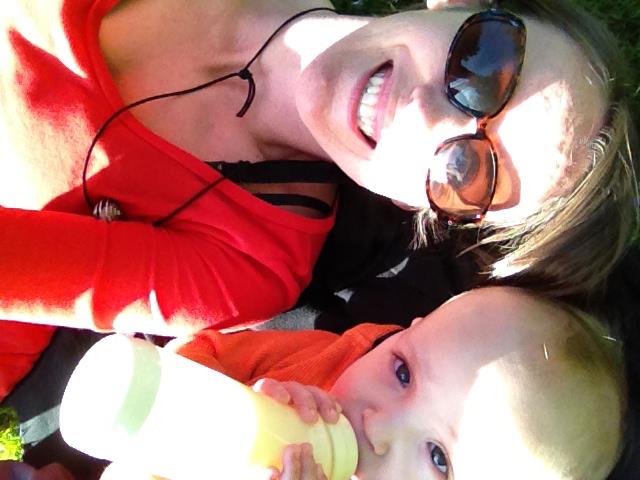
I dress him in an orange pullover and change into a red-orange top myself, colors of fire. Around my neck, I string my moonstone pendant. Moonstone: a crystal for femininity, fertility, and balance.
Keats and I walk to Green Lake instead of around it. We sit on a grassy bank, two of many taking in the spring sun. I’d planned to pick a daisy to be my flower, but a fallen blossom calls to me instead. The blossom has one flower for me and one for Keats, two flowers connected by a stem. I’m not surprised I was drawn to this one of all the flowers carpeting the ground.
I feel the silkiness of the pink petals. I admire their shape and their beauty, amazed by all that nature creates. These blossoms have let go of their hold on the tree above us, giving the leaves the space they need to grow.
Keats crawls around, inspecting twigs and leaves. I take a self-portrait of us, commemorating this moment, although I know I’ll remember it without the imprint. These moments we’re creating resonate with me. My body has provided all it could physically do for Keats, but I know my emotional reach will continue for decades. To have continued nursing for so long, balancing work and family, is something to celebrate. To see this little boy in front of me, so cheerful, so inquisitive – this is a time for happiness.
Keats grabs for my hands. He leads me, first toddling toward a shady patch, and then stooping down to touch a piece of bark. He looks up at me and babbles, a smile and a sound that both speak to the elation of his new discovery. I keep the bark, along with the blossoms. They’ll be an altar of renewal for us at home.
I scoop Keats up and pass through the trees to the path that skirts Green Lake Way. We stop to inspect more trees along the way, Keats reaching out to feel the texture of the bark. This little boy takes in the world around him, a reflection of his mama.
“How was it?” Dan asks when we return.
“Perfect,” I smile, and I mean it. I feel a sense of peace that’s been missing for a while. As I recognized upon Keats’ birth, my world has indeed expanded beyond myself. The year has swirled around me, a tornado of motherhood, balance, taking on, and letting go. And I’m still there, still standing at the center of it all.
 To Palimpsest
Katie, I really love reading your blogs. This one was amazing. If I was as great a writer as you, I would be able to tell you why I was totally immersed in everything you said. But as a person who was a working mom in education with a son who was born 8 weeks early who spent four weeks in NICU whom I nursed for nine (long, beautiful) months, I totally understood EVERY word you wrote. Please keep writing. And best wishes for your family on their impending arrival! ❤ Wendy
LikeLike