At bedtime, I asked Camden what the best part of this weekend was. He replied, “Going to Frankfurt,” but we didn’t go to Frankfurt. When I pointed that out, Cam revised his answer to “the place where people died.” I asked him what he liked about it, and he replied, “Everything.”
We’ve explored all four intermediate directions from our seat in the state’s capital: northeast to Celle, southeast to Hildesheim, southwest to Hamelin, and northeast to Bremen. Today, we pushed the boys’ endurance for a daytrip beyond Celle to Bergen-Belsen.
Bergen-Belsen was a POW camp until 1943, when part of it became a concentration camp. At least 20,000 POWs and 52,000 civilian prisoners died there before the Allies liberated the camp on April 15, 1945. Another 14,000 died after liberation. Among the civilian prisoners who didn’t survive were Anne Frank and her sister Margot.
When Dan and I had mulled over ideas for a daytrip, he’d suggested Bergen-Belsen. Our Lower Saxony day trips until today have taken us to the places of fairy tales. Other explorations around Hannover, Berlin, and Munich have given the boys an understanding of World War Two. Unbeknownst to us until late-night Googling yesterday, today would have been Anne Frank’s 93rd birthday. It seemed too poignant to go anywhere but Bergen-Belsen.
We drove out of Hannover this morning with the older two babbling in the back seat and Camden quietly looking out the window at our neighbourhood – the first streets to escape Allied bombers. Camden suddenly piped up with extreme joy in his voice, “I see the Ukraine flag!” Two of our neighbouring families have shared their homes with Ukrainian refugees in recent months, and Dan and I have talked with the boys about the barbarity of actions taking place only 800 miles from here. Camden has a radar for the yellow and blue of the flag.
Driving north, the boys’ giggles and questions and singing ensued, as they would at the start of any road trip. A flawless blue sky stretched over the fields and villages that we passed, but my stomach felt contrastingly knotted. I really didn’t know what to expect – of the camp, of the boys, of my emotions.
Near Bergen, we drove past a construction site with mounds of earth that reminded me of the ancient burial mounds around Stonehenge. They reminded Dan and me of a different kind of burial, too. The parallel felt incredibly uncomfortable, given where we were heading. I wondered if the inhabitants of the idyllic villages knew about the atrocities taking place just beyond their charming half-timbered homes 80 years ago.
I visited Dachau years ago, a solemn memorial site where the guards’ towers, fence, sleeping quarters, and ovens remain. I knew that Bergen would be different. With its absence of buildings, I expected a ghostly and dark atmosphere. Instead, it felt, surprisingly, both devastating and light. There’s sad comfort in knowing that the named and unnamed prisoners haven’t been forgotten.
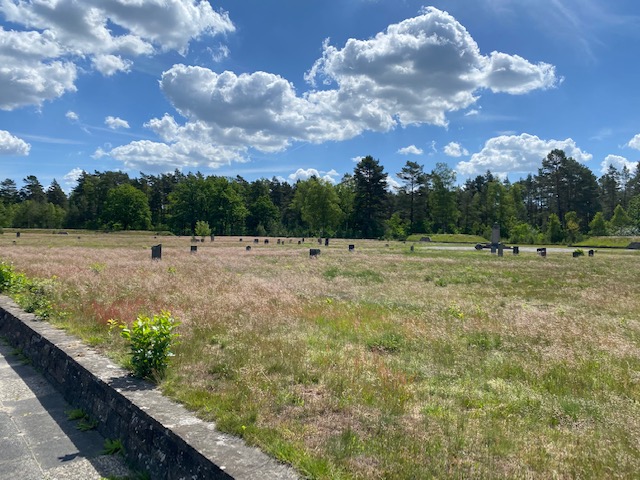
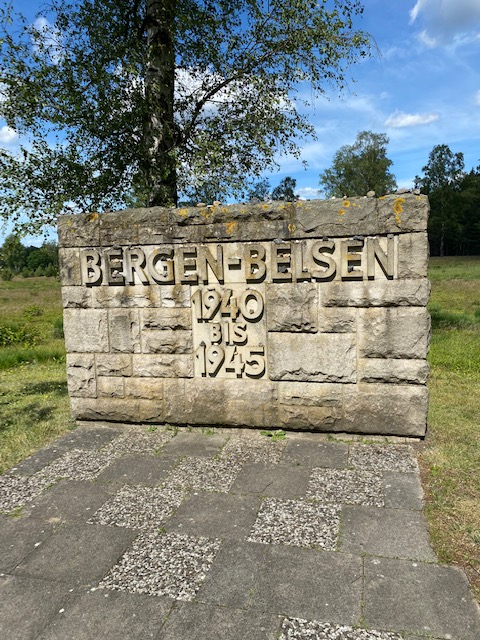
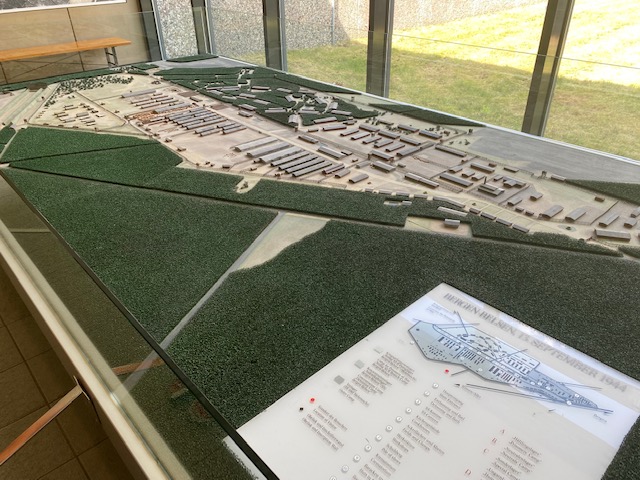
A wide, tree-lined path leads from the carpark before arriving at an open expanse of heathland that was once the camp. In sight of the Bergen-Belsen sign, we crossed over a grassy alleyway between the trees – the location of the fence that once surrounded the camp. A path took us around part of the 55 hectare memorial site, flanked on either side by mass burial sites, in which tens of thousands of nameless victims were buried. We then arrived at a symbolic graveyard, with gravestones inscribed for a handful of the camp’s victims, Anne and Margot included.

My youngest understood as much as a four year old can, but was mostly interested in the marbles, stones, and feathers that decorated Anne and Margot’s gravestone, the caterpillar that we watched inching across the path to the safety of the heath, and the shiny black beetle that took on a purple hue in the midday light.
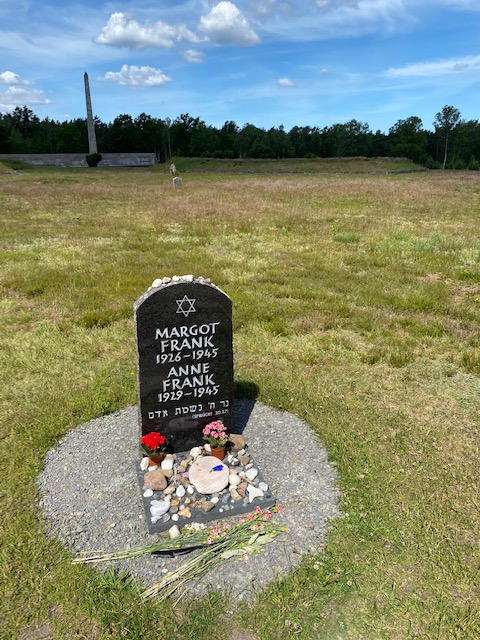
The older boys understood the gravity of what we were seeing. Their reach to hold hands was more frequent than usual, and their spontaneous hugs were tighter. “This is interesting and sad,” Wren mused as we walked from the Franks’ gravestone to the 24 meter tall obelisk and 50 meter long wall that serve as the central memorial.
When we arrived back in Hannover, we pulled up outside our building, parking behind our neighbours’ car. They were in the process of loading their car with household items to deliver to one of the Ukrainian families that has recently been provided housing. A local property owner has opened his apartments, subsidizing the first six months’ rent; the city council will cover the next six months.
Although Cam seemed more focused on the treasures he spied at Bergen-Belsen, his comment at bedtime tells me that the visit meant something more to him. I hope today’s visit lingers with the boys. I hope they recognise how fortunate we are to live when and where we do, in a place that remembers and learns from the past.
 To Palimpsest