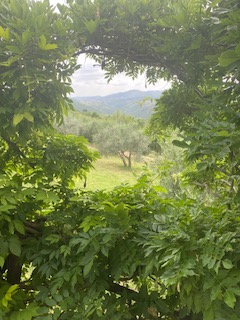
Mornings are spent with coffee, a book, and then time to write, always with a view over the hills that undulate beyond, like the curved backs of slumbering dragons. Lunch is a taste of Italy: oil and vinegar with bread and a plate of green olives, tomatoes, and cheese, eaten around the sun-bleached wooden table in the shade of the terrace. The afternoons are for escaping the heat in the pool at the opposite end of the property, past silver-green olive trees, fragrant lavender bushes, and potted lemon trees. It’s enchanting to see the stretched yellow globes hanging from branches instead of piled in a basket at the supermarket.
We’ve spent four days like this, only venturing to the nearby village of San Venanzo for dinner and the town of Marsciano for gelato. There, we discovered two new tastes of Italy in the unexpectedly delicious flavours of liquirizia (licorice) and pinoli (pinenut). These findings pulled us back a second evening, and our comments earned us a grin from the grandmotherly woman behind the counter, the tone of exclamatory words being universal.
Today, we explore further. Our destination is Spello, a medieval town of biscuit-beige brick perched on Mount Subasio in the heart of Umbria. Had we been there a month ago, we would have stumbled onto the Infiorate di Spello, an occasion in which 1,500 meters of floral carpets made from the petals of wild flowers cover the streets and squares. Instead, we’ll be there in the midst of Finestre, balconi e vicoli fioriti – Flowery windows, balconies, and alleys – an ongoing event that runs from May through August. The town’s inhabitants compete for the accolade of having the best floral display outside their homes or shops. Spello’s historic centre is alive with colour.
The 45-minute journey first takes us down a winding road to Marsciano, where the geography flattens and the velocity of cars increases. On our approach to the SS3bis highway that will carry us north, we pass a field of sunflowers, their faces tipped toward the sun. I’ve noticed that looking up toward the sky has become easier for me, too, now that it’s summer and I can linger in the details of places. Sometimes, it’s the moon partway through her monthly journey that catches my attention. Other times, it’s the clouds drifting overhead or the clear pinpoints of stars in the night sky.
Nearing Spello, Dan and I linger in the captivating sight of Assisi, a sprawling town of limestone built into the hills on our left, glowing under the mid-morning sun.
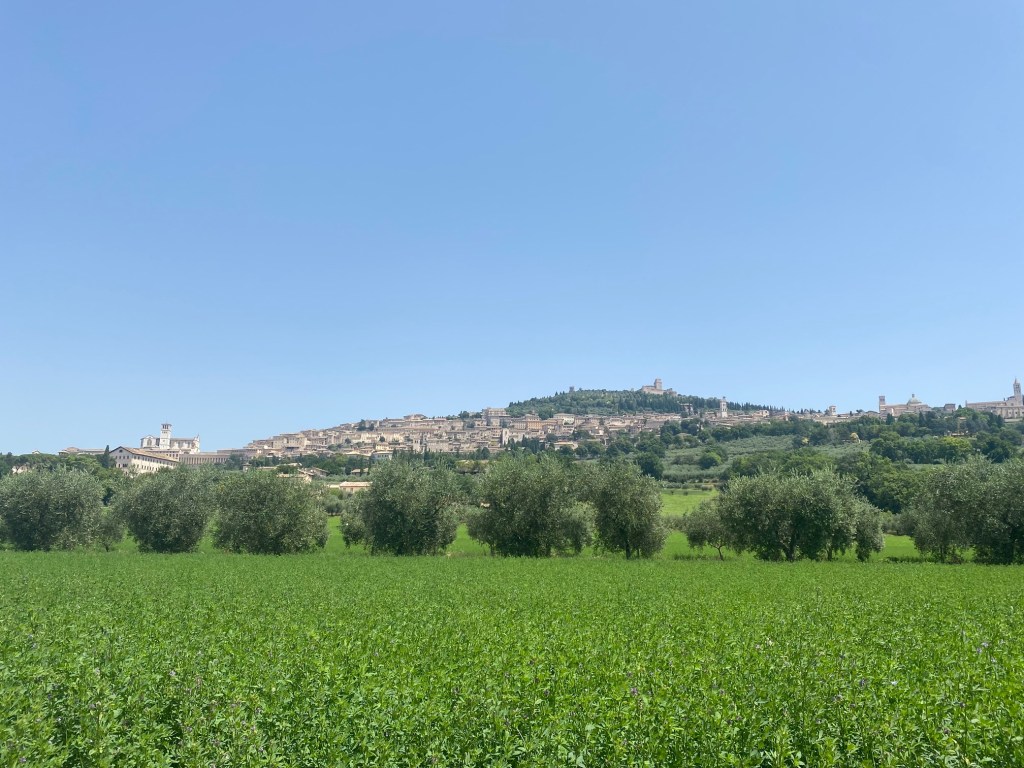
“Should we go there instead?” he ponders. Assisi catches my attention, but Spello has piqued my interest too much to let it go.
“We could do both,” I suggest, “but it might be too much for the boys.”
We glance sideways at each other. “We could do what we want to do,” Dan offers, and so we continue on to Spello with the tantalizing possibility of detouring to Assisi on the return journey.
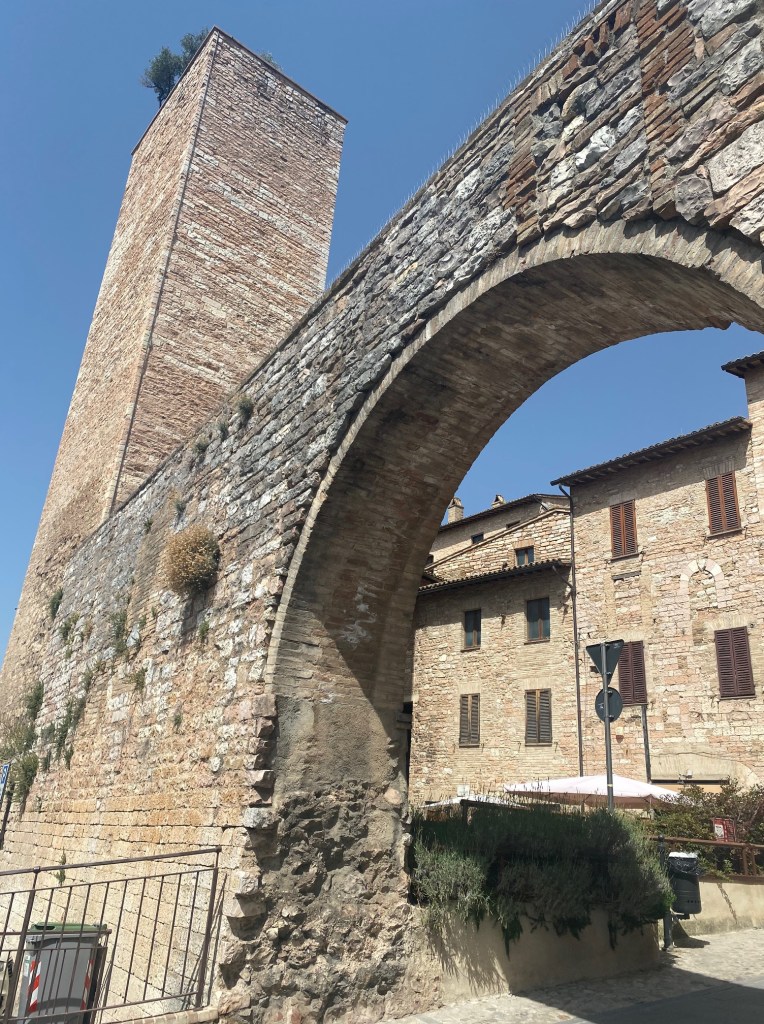
In Spello, we park just outside the remnants of the oldest fortified wall in Italy, which surrounds the town’s centre. Less than one hundred meters away stands a formidable medieval archway, the younger sibling of the adjacent first century BCE Porta Consulare. Between the two archways stands a medieval tower with a lone olive tree perched on top – a tree from which olives are apparently collected when the harvesting season arrives.
Camden and I walk through the archway and step into a fairytale. Via Consolare gently winds uphill to our right, ushered along by the jumbled limestone brick of shops and homes. Hanging baskets, window boxes, and terracotta pots pop with the pinks and purples of petunias against the mellow yellow-white of the walls. We follow the road up and around, and Camden spies the tell-tale sign of a cafe: a few square tables and metal chairs arranged on the cobblestones. “We should stop there,” he declares.
Dan and the older boys catch up to us. “The croissants look good,” Dan observes, noticing the cafe. “Should we give it a try?”
I chuckle, “Camden had the same suggestion.”
And because we learned long ago that sated bellies improve the likelihood that the boys will skip ahead instead of drag behind as we explore, we stop.
The boys rush to the fridge and pull out three Powerades. Powerade has become their magical elixir after their first taste a few days before. On my request, they select slightly less sugary drinks, and we gather around the glass counter, sizing up the assortment of pastries below. My Italian skills have only improved from understanding that due cappucino should be due cappucini. Thus, ordering beyond that is a series of pointing at pastries and gesturing to an orange (for Wren) while forming a circle with my fingers, followed by extending one finger up. I think I’ve successfully communicated that we would like one whole orange, two coffees, three soft drinks, and four croissants.
We find a table outside and sit down. The coffees and soft drinks arrive, as do the pastries, although not as many as I thought I’d ordered. Then the server places a glass of freshly-squeezed orange juice on the table, and I understand that the oranges on display were not meant to be segmented and consumed, as my nine-year old had hoped. He looks perplexed, but then guzzles the juice and gives it his approval.
Still, the receipt doesn’t make sense to me. The number of items and their prices don’t align with our order. At the cash register, I understand the server’s tre Powerade as she points to the charges of 3 Euros, but shaking my head and pointing isn’t enough to communicate, “The boys originally took Powerade from the fridge, but I told them to put the drinks back.” I turn to a translation app on my phone to explain this and to say that I would like to buy two additional croissants, please. Lacking language is a humbling experience.
The coffee is excellent and the croissants are the best we’ve had in Italy: warm, buttery, and flaky. Having spent time in France, Dan and I have high expectations of pastries.
As expected, the boys are soon ready to explore. We leave the cafe and continue up the road, pressing ourselves against the brick walls as cars squeeze through the narrow lanes. Although varied floral arrangements decorate the buildings, one specific essence permeates the air; the musky tang of tartufo, truffles, prevails. This part of Italy is known for Tuber Melanosporum Vittadini, prized black truffles that thrive in the limestone-clay earth. Two nights before, when we inadvertently ordered a huge, meat-heavy antipasto in San Venanzo, the lone truffle bruschetta was mine.
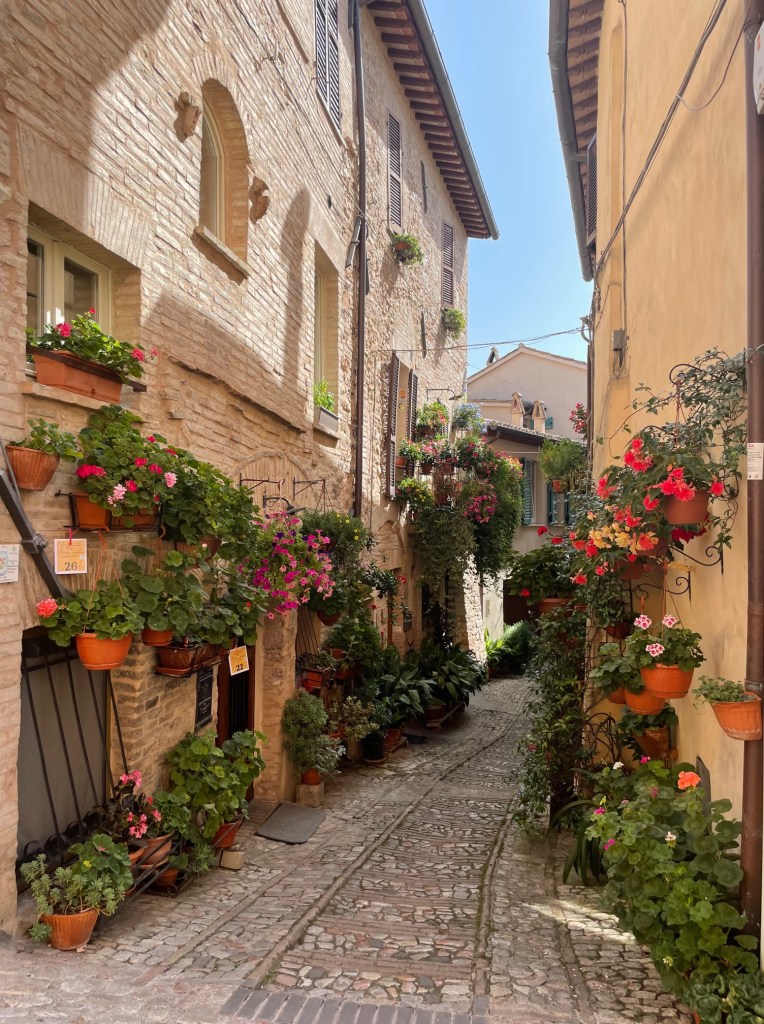
Now meandering through Spello, we pass stores dedicated to the products of Umbria: flowers, olives, and truffles. There’s the Acqua ai Fiore di Spello shop, displaying pastel bottles – pale blue, pink, and yellow chosen to reflect the floral scents of perfume within, perfumes with musical names like Balconi Fioriti, Fioritura, and Raccolta. We wander into a shop selling olivewood bowls and bread boards, instantly recognisable for their rich and tempting caramel swirls of colour. We walk past a bottega with a rounded archway over its wooden door and peer into the low-lit, cave-like interior. The dim lighting matches the dark, earthy truffles on display in the window.
We walk past the town’s most renowned church, Santa Maria Maggiore, built centuries ago on the site of a temple dedicated to two Roman goddesses, Vesta and Juno. I appreciate walking where Juno’s worshippers once did. Juno: the chief goddess who was connected with all aspects of womanhood, especially married life. Me: the solo goddess in a family of five.
Like all of the towns we’ve visited in Italy, the number of churches is astounding. Spello, with a population of only around 8,500 has more than a dozen of them.
One hundred meters from Santa Maria Maggiore, the door to the next church, Chiesa di Sant’Andrea, stands open. We walk into a hushed space containing the familiar musty air of a Gothic church and a soaring, light-filled vaulted ceiling. The 16th century art work on the walls includes a collaborative fresco by Raphael’s contemporary, Pinturicchio, and others. Dan and I marvel at the money, time, and effort that must have been dedicated not only to the creation of this church, or even to the other dozen within this town, but to the tens of thousands spread throughout the country.
This place is a wonder. This place – Italy – and the cities within it. I’ve always loved traveling, but the past three years living in Europe have exponentially increased my thirst to explore. I want to see as many places as possible, immersing myself in the sights, the sounds, the tastes, the smells, and the feelings. I want to be present, but I’m always aware of a nagging sense of how fleeting these moments are. I scribble notes in a little pink notebook that comes everywhere with me, tucked into my travel bag. The notes are a messy shorthand of the five senses that reflect a desperate desire to live it all and hold onto it all.
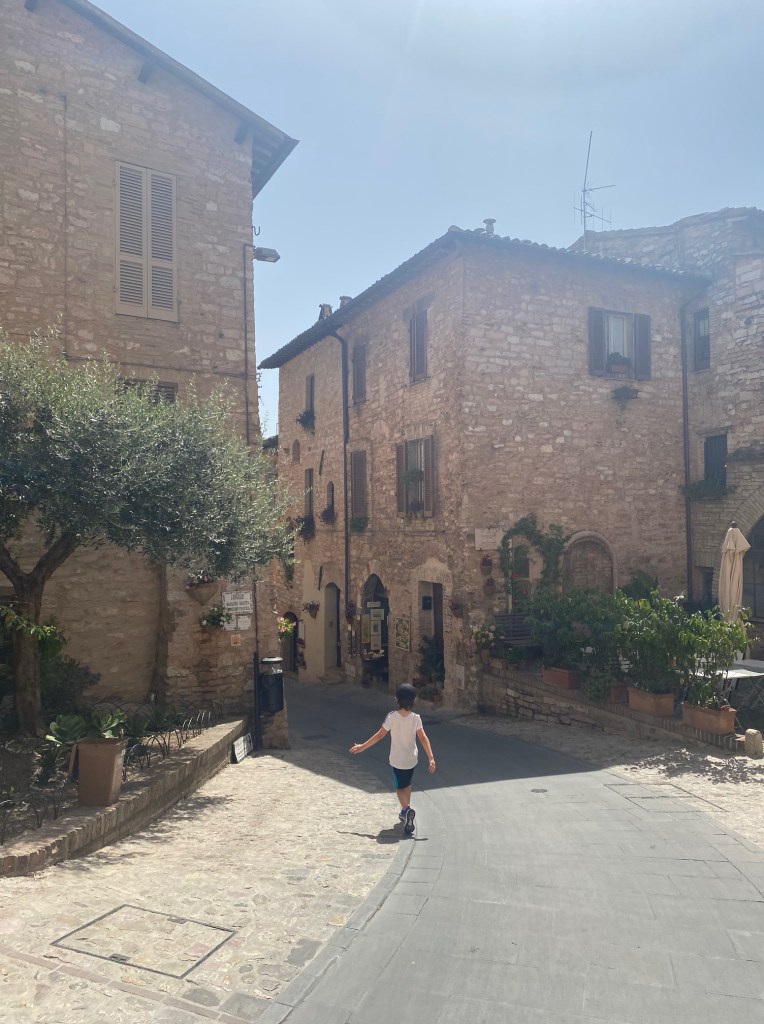
After trekking to the view of the valley from Spello’s highest point and then winding our way back down through the town, we pile back into the car, and Dan and I decide to do what we want to do: Assisi. We drive the 12 kilometers there. Our first stop after passing through Porta Nuova is to buy lemon and watermelon granitas. With that, the boys’ thirst is quenched enough to continue along the sloping road that fills our senses in our quixotic quest to drink in all that this world has to offer.
 To Palimpsest