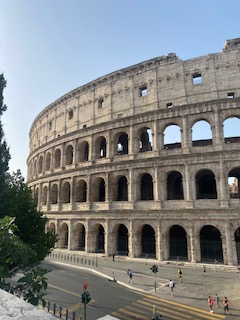
Morcheeba’s “Rome Wasn’t Built in a Day” fills the car as we approach the city. The boys’ education is one of travel and music.
Between the 16th and 19th centuries, aristocratic young men from northern Europe undertook a Grand Tour, completing their education with a journey through France and Italy. My family is doing something similar, although we’re not aristocratic and our multiple year tour is interspersed with the necessities of school and work.
Throughout July, we’ve driven from northern Germany through France and Switzerland. A meander from the Italian Alps, through San Marino, down the Adriatic Coast, and back inland has led us here.
This is clearly Rome. The traffic has become a chaos of cars nosing into main thoroughfares from side roads and mopeds zipping in and out. The nondescript apartment blocks on the city’s outskirts have given way to ornate facades woven with ancient ruins. We park the car in an underground garage just outside the Zona Traffico Limitado of the city’s historic centre. To cross into this inner sanctum of the city in our vehicle would incur a fine equal to a night’s stay in the apartment Dan’s booked. The flat is a last minute find, a treasure excavated from the Internet. Not cheap, but worth every Euro.
The eight-minute walk from the parking garage acquaints us with the uneven footing of Rome’s pavements, the oppressive heat, and the importance of being assertive pedestrians. Waiting politely at a crosswalk means minutes will tick by before a pause in traffic opens up. Instead, we look to ensure there’s enough room for an oncoming vehicle to brake, and then we stride out into the street. A gap soon widens as Keats keeps up with Dan’s stride and I bring up the rear with Camden, who keeps his hand in mine, and Wren, who stops to inspect the trinkets in every souvenir shop along the way. He’s intrigued by the centurion helmets and knock-off professional football jerseys, the closest he’ll get to his current dream of meeting Roma’s Paulo Dybala.
It sounds too privileged to say we have a penthouse apartment, but we do: two floors all to ourselves. We pick up the key from a lockbox nearby. On one side of a heavy green door are the crowds of milling tourists and an abundance of mediocre restaurants, leather shops, and fashion stores trying to attract our attention along the Via in Arcione. On the other side is a quiet, cool courtyard. Once through the courtyard, another door to our right opens to a pristine replica of a sculpted Roman goddess. Around the corner beyond her is a rickety lift that we squeeze into for the journey to the fifth floor. Dan jiggles the key in the lock unsuccessfully before it opens from inside. The apartment is still being prepared. Thorough inspection of it will have to wait. We deposit our bags and pause outside to make a plan. The Trevi Fountain is a three-minute walk away. The Spanish Steps are an eight-minute walk further. We’re in the throbbing heart of this city.
We navigate back along the busy street until it opens out to the convergence of three roads at the Piazza di Trevi. Oceanus rises before us, reimagined by the Baroque architect Nicola Salvi in the 18th century after numerous false starts by others. Winged water horses and mermen pull the Greek sea god in his seashell chariot over travertine cliffs. I catch a look of disdain on his face. Instagrammers abound. The woman next to us poses for multiple pictures, smiling serenely as her friend finds the best angle to eliminate evidence of the swarm of people around. Oceanus ignores us all, fixing his gaze at a distant point above our heads. We pause to apply sunscreen.
Everyone’s hot. Everyone’s thirsty. Everyone’s tired. Camden keeps stopping to scratch his mosquito bites. Heat intensifies the itch.
We duck into a Carrefour Express and emerge with a tub of cherries to share and cold drinks for everyone. Pausing outside in the shade, I hold my can of Coke against the angriest bump on Cam’s calf.
“Does that feel better?” I ask him.
He closes his eyes and sighs in relief.
Everyone’s a little cooler, a little more hydrated, and a little more energized. We continue on to the Piazza di Spagna, the triangular pause in the crisscrossing streets. Some of the multi-storeyed buildings overlooking the piazza have closed their shutters to the throngs of rabble below; others study us with half interest, wooden shutters thrown open against the creamy yellows and oranges of their external walls.
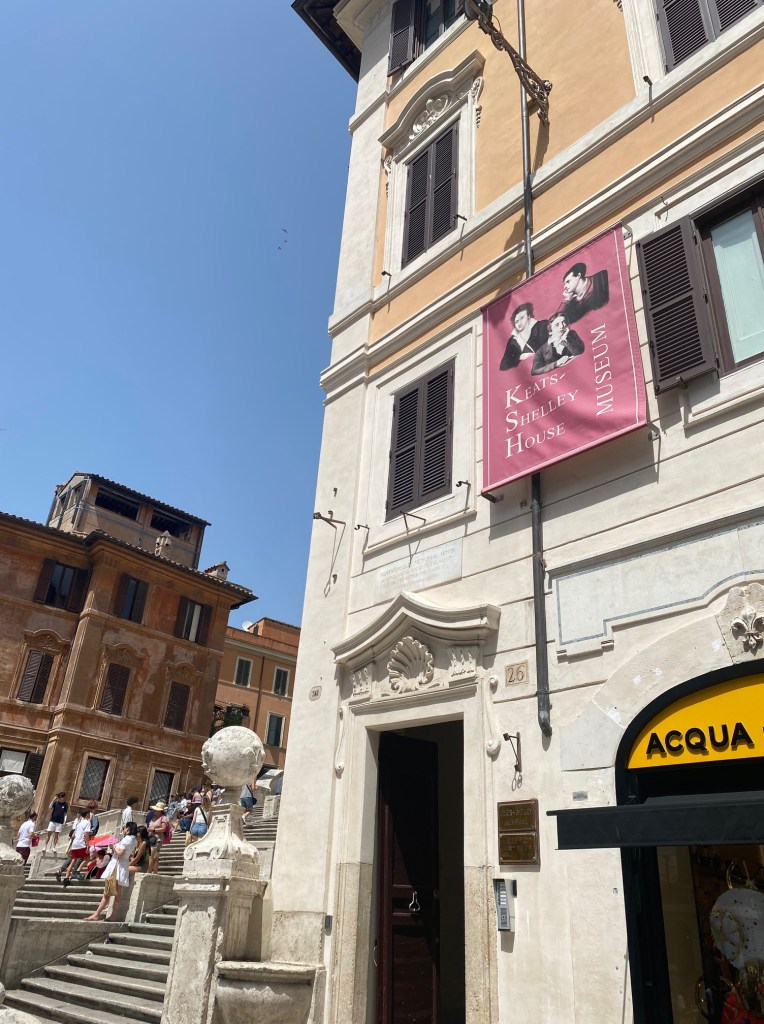
We stand in front of a four storey building adjacent to the Spanish Steps. A pink banner halfway up the wall proclaims that this is the Keats-Shelley House Museum. It was illness and debt that drove the poet to Rome while his contemporaries completed their Grand Tours. Here, John Keats spent his last days, exhaling his final breath at the too-soon age of 25 in 1821, unaware of his future fame. Now, 200 years later, his 11-year old namesake stands under his window.
We’ve spent five hours in the car; we’ll have less than 24 hours here. I want to forge ahead through the wall of heat, contend with the milling hordes, and bask in Rome. If I were here alone, I would. If it were just Dan and me, we would. But decision making for a family of five is different. The boys are wilting. We’ve made it to the Spanish Steps, but we don’t manage the few strides further to see the Fontana della Barcaccia. Less like the tourists that we are and more like the sensible Italians who shutter their businesses for siesta in the heat of the day, we turn our backs on the Spanish Steps to retrace our own.
The apartment is a good fit for five and comes equipped with both air conditioning and fans. On the lower level is an open living space with pictures and trinkets that belong in Central America more than central Italy. The art reminds me of the pieces I brought back from Honduras: a village painted with rounded lines and bright colours – whitewashed stucco walls, orange tiled roofs, a periwinkle river that matches the opposite wall of the apartment. The bookshelves contain an abundance of travel books: a walking guide to Rome, Rick Steves’ Italy. There’s a small, well-equipped kitchen and stairs that wind up against the blue wall to two bedrooms and a bathroom. At the top of the stairs, I find a locked door to the outside. A wrought iron staircase spirals up and out of sight. I assume it accesses something mundane – a utility area, perhaps.
We move fans around, we open windows. We allocate who will sleep where when night falls. We discover the apartment’s secrets. The boys find a second bathroom behind a door that I had assumed was a closet. Dan comes down the stairs.
“This is worth every penny,” he comments. “That view…”
From the windows, I can see out to the street below.
“The roof,” Dan prompts.
“We can go up there?”
He nods. “Best part of the apartment.”
And it truly is. I steal up the stairs to the second floor, unlock the external door, step onto the small landing, and climb up and around on the narrow spiral stairway, emerging on the roof.
Rome is breathtaking.
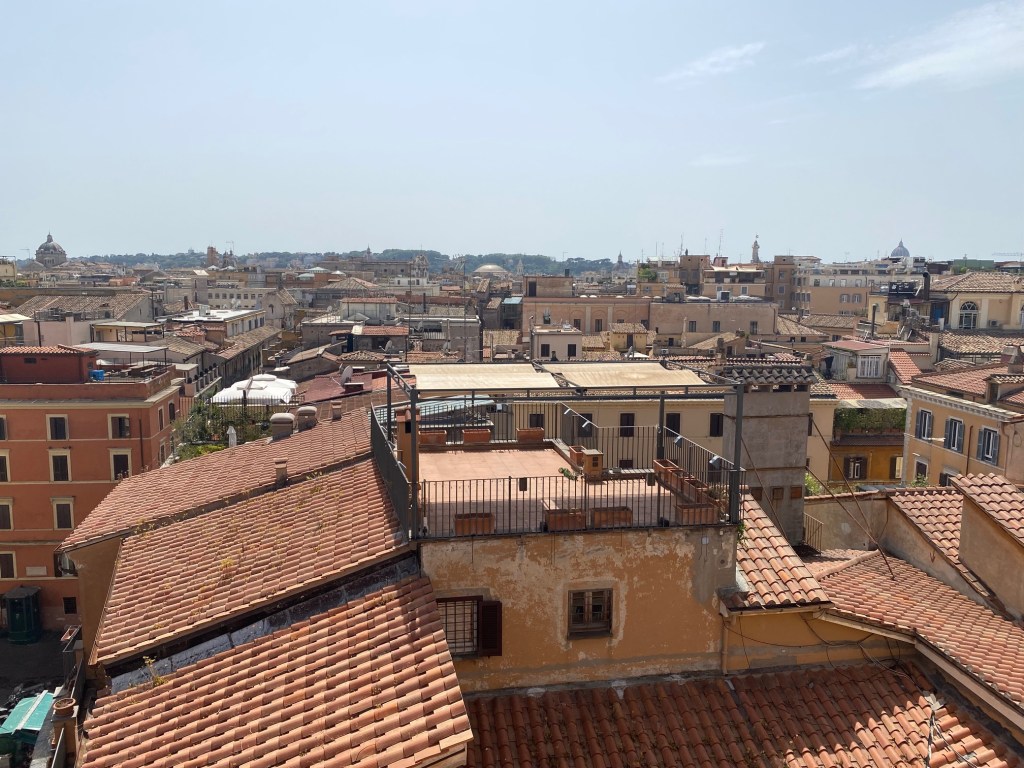
The city spreads out in every direction, a sea of rooftops in brown, yellow, and orange under a hazy pale blue sky. The ancient concrete dome of the Pantheon protrudes amidst the tangle of buildings directly ahead of me. To its right is Vatican City in the form of St. Peter’s Basilica, the dome of which reaches even higher into the sky. The view directly down to the street below is dizzying. To consider the layers of history all around me is even more so. For now, we’ll shed our layers of sticky, sweaty clothing and rest. The city awaits.
“Trevi Fontain. Monumento in Stile Tardo Barocco. Architetto Nicola Salvi.” ArcheoRoma, 2023, http://www.archeoroma.org/sites/trevi-fountain/.
Zelazko, Alicja. “Grand Tour.” Encyclopædia Britannica, http://www.britannica.com/topic/grand-tour. Accessed 5 Aug. 2023.
 To Palimpsest